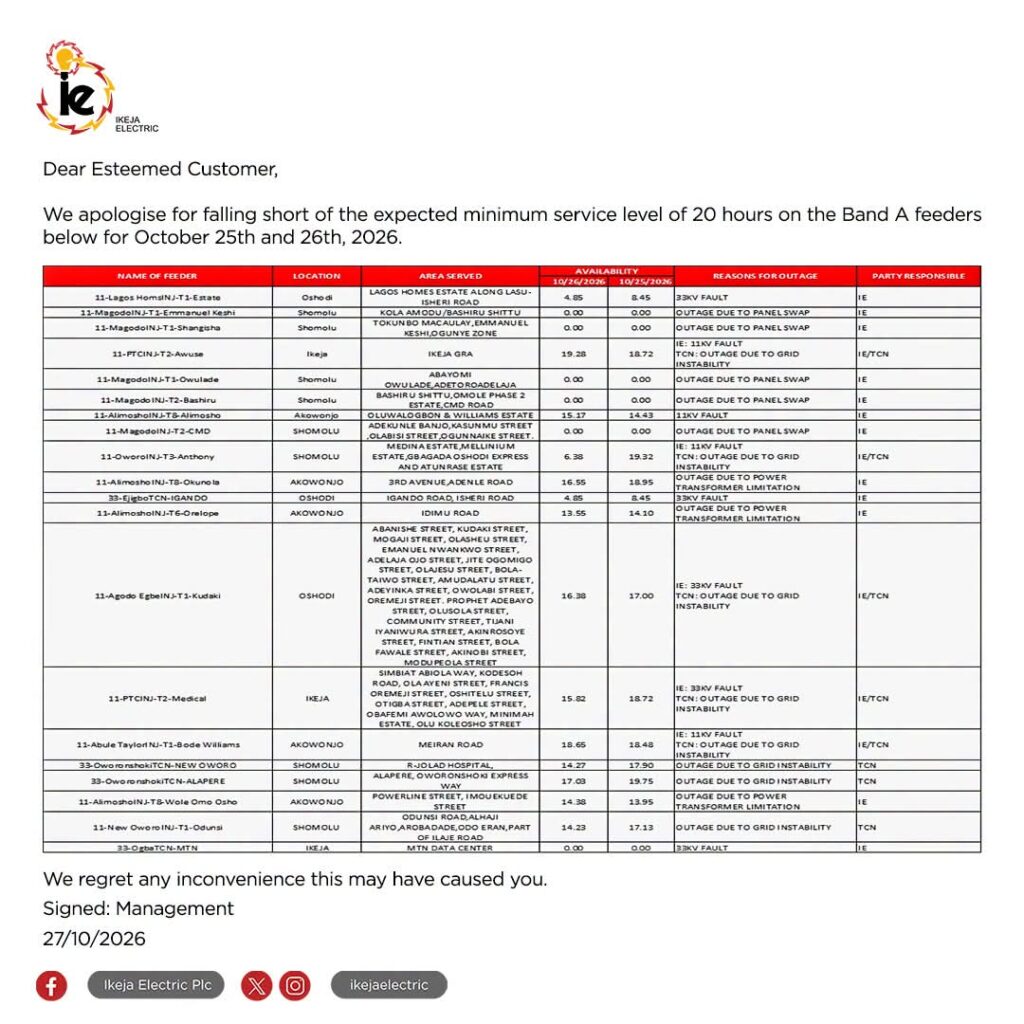
In a development that is likely to reignite concerns over power supply reliability in Nigeria’s commercial capital, Ikeja Electric Plc, the country’s largest electricity distribution company by customer base, has publicly acknowledged its inability to meet the minimum electricity supply commitment promised to customers on its premium Band A feeders.
In a notice addressed to customers, the utility company apologized for failing to deliver the expected minimum of 20 hours of daily electricity supply to several Band A feeders on October 25 and 26, 2026.
The brief but significant message read:
“Dear Esteemed Customer,
We apologize for falling short of the expected minimum service level of 20 hours on the Band A feeders below for October 25th and 26th, 2026.”
The admission is expected to fuel fresh debates over service delivery standards, tariff structures, and accountability within Nigeria’s power sector.
Premium Tariffs, Unmet Expectations
Band A customers occupy a unique category within Nigeria’s electricity pricing framework. They are charged some of the highest electricity tariffs in the country on the understanding that they will receive a minimum of 20 hours of power daily.
The category includes major residential estates, commercial districts, corporate offices, financial institutions, manufacturers, technology hubs, healthcare facilities, and other high-demand users who rely heavily on stable electricity for operations.
For many consumers, the latest disclosure raises difficult questions about value for money.
Customers argue that while tariffs have risen significantly over the past few years, service reliability has not always reflected the premium rates being paid. The acknowledgment by Ikeja Electric may therefore intensify calls for compensation mechanisms whenever agreed service thresholds are not met.
Growing Pressure on Distribution Companies
The incident places additional scrutiny on electricity distribution companies, popularly known as DisCos, which continue to face mounting pressure from regulators, consumers, and industry stakeholders to improve performance despite persistent challenges across the power value chain.
Power shortages, transmission constraints, generation fluctuations, equipment failures, and network maintenance activities have frequently disrupted supply, often leaving distribution companies struggling to meet service obligations.
Nevertheless, consumer advocates insist that service commitments should not be optional, particularly for customers who bear the burden of higher tariffs under the Band A classification.
Businesses Feel the Impact
For businesses operating within Ikeja Electric’s network coverage area, every hour of lost power translates into higher operating costs.
Many firms are forced to rely on diesel generators and alternative energy solutions whenever grid supply falls below expected levels. With fuel prices remaining elevated, businesses say prolonged outages can severely erode profitability and increase the cost of goods and services.
Small and medium-scale enterprises are especially vulnerable, as many operate on thin margins and have limited capacity to absorb rising energy expenses.
Demand for Greater Transparency
Industry observers say customers increasingly expect utilities to move beyond apologies and provide detailed explanations whenever supply obligations are not met.
Stakeholders are calling for clearer disclosures on:
•The causes of supply shortfalls.
•The duration of outages.
•Affected communities and feeders.
•Corrective measures being implemented.
•Plans to prevent future disruptions.
Consumer rights groups have also urged regulators to strengthen monitoring mechanisms and ensure that electricity companies are held accountable for service-level commitments attached to tariff structures.
A Test for Customer Confidence
While Ikeja Electric’s willingness to publicly acknowledge the shortfall may be seen as a step toward transparency, the incident underscores the broader challenges confronting Nigeria’s electricity sector.
For thousands of households and businesses depending on the utility, the issue is no longer simply about apologies. It is about whether promised service levels can be consistently delivered in exchange for the higher tariffs customers are required to pay.
As energy consumers continue to demand better reliability, the latest admission by Ikeja Electric serves as a reminder that restoring customer confidence will require more than assurances. It will require measurable improvements in power delivery, network stability, and accountability across the electricity value chain.